
Montana Bridge Company FAQ Everything to Know Before You Build a Bridge
62 plain-English answers about custom pedestrian and vehicular timber bridges, driveway bridges, boardwalks, golf course crossings, load ratings, cost, process, and where Montana Bridge Company builds. Founder-led by James York, a nationwide timber bridge builder since 1985. Call (813) 694-4244 for a free site consultation.
About Montana Bridge Company
-
Montana Bridge Company (MBC) is a nationwide timber bridge design, engineering, and construction firm that builds custom pedestrian and vehicular bridges, boardwalks, and covered bridges for private landowners, developers, golf courses, HOAs, municipalities, and parks departments across the United States. The company is founder-led by James York, who pioneered the American timber bridge industry starting in 1985, and it handles design, engineering, on-site construction, and long-term maintenance under one roof.
-
James York is the founder of Montana Bridge Company and one of the most influential figures in modern timber bridge construction. In 1985 he founded what became the largest nationwide timber bridge company in the United States, and over roughly 38 years his teams designed and built thousands of structures across four continents. After stepping away from the industry, he returned to found Montana Bridge Company, bringing the same design-build approach to a boutique, founder-led firm.
-
Montana Bridge Company's leadership brings over 70 years of combined bridge-building experience and a legacy of more than 8,000 bridges built for more than 3,800 clients across four regions: the USA, Mexico, Europe, and the Caribbean. Founder James York has been designing and building timber bridges for about 40 years.
-
Yes. Montana Bridge Company is fully licensed, insured, and bonded, and it maintains working relationships with county, city, and state agencies. Engineered bridge drawings and structural calculations are sealed by a licensed engineer for permitting and construction.
-
Yes. Despite the name, Montana Bridge Company is a nationwide timber bridge builder headquartered in Tampa, Florida. It actively serves Florida, North Carolina, Montana, Wyoming, Colorado, Utah, and other states, and it has built bridges internationally. If your project is anywhere in the United States, call (813) 694-4244 to discuss it.
-
Montana Bridge Company is based in Tampa, Florida (P.O. Box 341021, Tampa, FL 33694) and builds bridges across the United States. Because every bridge is constructed on the client's site by MBC's own crews, the company's location matters far less than its ability to mobilize to yours.
-
You can reach Montana Bridge Company at (813) 694-4244. Call to talk through a crossing, request a preliminary budget estimate, or schedule a site consultation. You can also use the contact form at montanabridgecompany.com/contact.
-
Montana Bridge Company builds custom timber pedestrian bridges, vehicular bridges, driveway bridges, covered bridges, golf cart and golf course bridges, boardwalks, covered walkways, pedestrian road overpasses, and piers. Structures range from single-span crossings to multi-span bridges and long continuous boardwalks over wetlands.
-
Yes. Montana Bridge Company designs and builds single-lane, double-lane, and multi-lane vehicular timber bridges for private roads, ranches, residential developments, commercial developments, schools, business parks, and public access routes. Vehicular bridges are engineered to recognized load standards such as HS-20 and AASHTO LRFD HL-93 and can be designed for everything from light passenger traffic to fire apparatus, delivery trucks, and heavy equipment.
-
Yes. Montana Bridge Company builds pedestrian timber bridges for walking paths, parks, trails, campuses, greenways, private estates, and public spaces, including boardwalks, covered walkways, and pedestrian overpasses. Each pedestrian bridge is engineered for structural reliability and long-term durability while blending into the surrounding landscape.
-
Yes. Driveway bridges are one of Montana Bridge Company's core products. MBC engineers custom driveway crossings over creeks, canals, streams, ravines, and wetland channels for single-family homes, rural acreage, ranches, and shared HOA access, including fire-code-compliant emergency-vehicle crossings and heavy-load bridges for trucks and equipment.
-
Yes. Montana Bridge Company builds classic timber covered bridges for both vehicular and pedestrian use. A covered bridge combines architectural presence with structural protection, since the roof shields the deck and structure from weather and extends service life while creating a visual landmark on the property.
-
Yes. Montana Bridge Company builds custom timber boardwalks and elevated walkways across wetlands, marshes, waterfronts, sand, and other soft or environmentally sensitive terrain. Boardwalks use continuous foundation systems such as driven timber piles or pier-and-beam supports, and are often built top-down from the deck itself so no heavy equipment touches the ground below.
-
Yes. Golf course bridges are a specialty of Montana Bridge Company. Founder James York has designed iconic crossings on championship courses nationwide. MBC builds golf cart bridges, in-play crossings, and maintenance-vehicle bridges on both new course construction and established, in-play courses, coordinating with superintendents and course builders to protect turf and minimize downtime.
-
Yes. Properly engineered timber bridges carry highway-level loads. Montana Bridge Company designs vehicular bridges to HS-20 and AASHTO LRFD HL-93 live-load standards, which cover design trucks, tandem axles, and lane loading, so a timber bridge can be rated for fire trucks, delivery trucks, livestock trailers, and construction equipment.
-
Montana Bridge Company bridges cross wetlands, ponds, streams, creeks, canals, lakes, rivers, ravines, gulches, dry washes, floodplains, roads, driveways, and environmentally sensitive areas. Both free-span (single-span, no in-water piers) and multiple-span designs are available depending on the site.
Types of Bridges We Build
Engineering, Load Ratings & Design
-
HS-20 is a long-standing AASHTO standard design vehicle loading used to rate a bridge's capacity for highway-scale trucks. An HS-20 load-rated timber bridge from Montana Bridge Company is engineered with full structural calculations, load analysis, and sealed plans so it can safely carry demanding vehicle loads such as fire apparatus, delivery trucks, and heavy equipment, not just passenger cars.
-
HL-93 is the AASHTO LRFD live-load model, the modern standard governing vehicular bridge design in the United States. It combines a design truck, a design tandem, and a lane load to represent the real load combinations a bridge will see over its life. Montana Bridge Company designs and seals HL-93 rated vehicular bridges, including the Denver, Colorado market where it is specifically offered.
-
Yes. Montana Bridge Company provides engineered, sealed drawings and stamped structural calculations for every bridge. The design process starts with plan, section, and profile drawings for an initial submittal, then progresses to a full detailed drawing set, and finally to sealed engineering that the client can use for permitting and construction.
-
No. Montana Bridge Company does not rely on standardized or catalog bridge plans. Every bridge is designed for its specific location, accounting for span length, terrain, hydraulics and flood flow, soil and foundation conditions, traffic demands, and the aesthetic goals of the property. MBC also does not build other firms' designs.
-
A free span bridge crosses a waterway in a single span with no piers or footings placed in the creek bed or floodplain. Montana Bridge Company builds free span bridges because they let water, sediment, and debris pass unobstructed during floods, reduce erosion and maintenance, and are often preferred by permitting agencies. Longer free spans typically use engineered glue-laminated (glulam) beams.
-
A design-build firm handles design, engineering, and construction under one contract and one team. Montana Bridge Company is a true design-build timber bridge company: the same in-house team is responsible from concept through sealed engineering, on-site construction, and post-construction maintenance, which eliminates hand-offs between separate designers and contractors.
-
Yes. Montana Bridge Company uses 3D terrain modeling to fit each bridge precisely to the site, coordinate abutment and foundation placement, and confirm clearances and approaches before construction begins.
-
Yes. Montana Bridge Company designs ADA-compliant accessible walkways and boardwalks for public parks, campuses, and commercial properties, with appropriate widths, slopes, railings, and surfaces for inclusive access.
-
Yes. Montana Bridge Company engineers fire-rated and emergency-vehicle-access bridges for rural, waterfront, and foothill properties where the fire code requires that a driveway crossing support fire apparatus. Load ratings, width, and turning requirements are built into the sealed design.
-
Montana Bridge Company builds primarily with treated timber and timber piling, using engineered glue-laminated (glulam) beams for longer spans and higher performance requirements. Depending on the project, MBC also integrates structural steel components, hardwood elements, composite or structural plastic components, corrosion-coated bolts and hardware, and protective paint or stain systems.
-
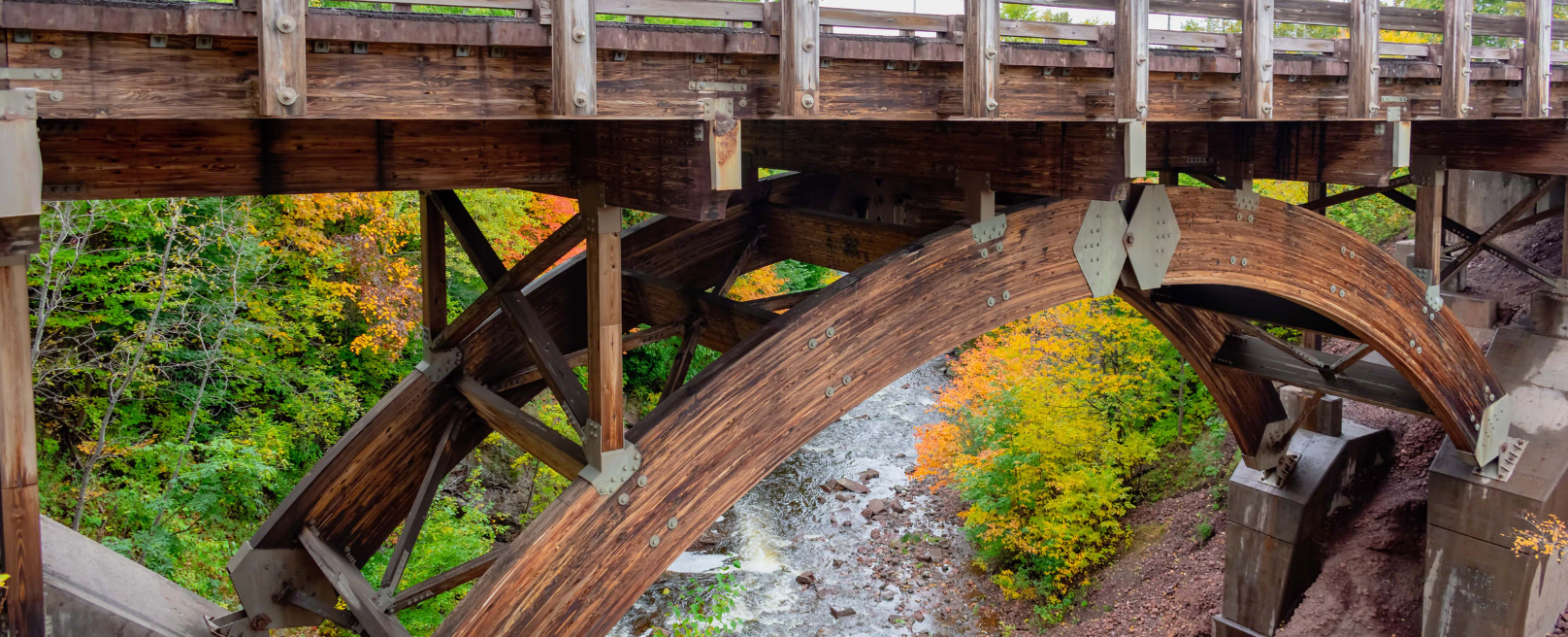
A glulam or laminated timber bridge uses engineered glue-laminated beams made from layers of dimensional lumber bonded under pressure. Glulam beams are stronger, straighter, and more dimensionally stable than solid sawn timber, which allows longer spans, higher load ratings, and greater design flexibility. Montana Bridge Company offers laminated vehicular bridges in markets such as Bozeman and Missoula, Montana and Salt Lake City, Utah.
-
A properly designed and maintained timber bridge lasts for decades. Montana Bridge Company designs against moisture, decay, and UV exposure using advanced treatments and coatings, and references a 75-year lifespan when calculating the carbon stored in its timber bridges. Regular inspections and maintenance are the biggest factor in reaching that lifespan.
-
Montana Bridge Company engineers every bridge against moisture from the design stage: drainage and clearance are calculated for flood flow, timber is pressure-treated and protected with advanced treatments and optional paint or stain systems, bolts and hardware are coated to resist corrosion, and details are designed to shed water rather than trap it. An optional longevity package adds coatings and painting during construction.
-
Yes. Montana Bridge Company designs foundations and abutments for freeze-thaw cycling, spring runoff, flash-flood drainage, and high-altitude exposure in Billings, Bozeman, Missoula, Cheyenne, Casper, Denver, and Salt Lake City. Timber performs well in cold climates, and glulam beams provide the stiffness and capacity needed for snow and vehicle loads.
-
Yes. Timber is a renewable material that stores carbon for the life of the structure, and Montana Bridge Company sources responsibly harvested timber from regional American mills. MBC builds top-down from the deck whenever possible so heavy equipment never enters wetlands, streambeds, or fragile habitat, and it uses recycled or reclaimed materials when available.
-
Top-down construction means the bridge or boardwalk is built from its own deck, advancing outward as each section is completed, so no heavy machinery operates on the ground, in the water, or in wetlands below. Montana Bridge Company uses top-down methods on sensitive sites to protect soil, water flow, wildlife corridors, and turf.
Materials, Durability & Longevity
Process, Timeline & Site Requirements
-
Montana Bridge Company follows a defined design-build process: (1) Pre-contract review of your civil drawings, sketches, and site photos, a preliminary design assessment, and an initial budget estimate; (2) an optional site visit and final scoping of materials, aesthetics, and environmental considerations; (3) contracting; (4) design and engineering through sealed drawings; (5) permitting support while you secure permits; (6) scheduling and mobilization prep; (7) on-site construction with a client walkthrough and punch list; and (8) post-construction documentation and a first maintenance visit four to six months after completion.
-
Montana Bridge Company does not pull permits on the client's behalf, but it fully supports the permitting process by providing sealed bridge drawings and stamped calculations, answering agency RFIs, and meeting with permitting agencies alongside the client as needed. Clients have credited MBC's permitting expertise with saving months of delays.
-
No. Montana Bridge Company does not prefabricate. Every bridge is built on site by MBC's own crews. Treated timber, piling, structural steel, and specialty materials are delivered to your property and fabricated and assembled in place, which lets the crew respond to actual terrain, hydrology, access, and the architectural character of the property.
-
Timelines depend on span, complexity, engineering, and permitting, so Montana Bridge Company sets a realistic schedule with each client during scheduling and mobilization prep. Because MBC completes each project fully before moving to the next, construction dates are firm once set. Engineering and permitting typically take longer than the build itself, which is why many owners design and order in fall or winter for a spring installation. Call (813) 694-4244 to get a timeline for your crossing.
-
Before mobilization, Montana Bridge Company sends written documentation of site preparation requirements, which typically include survey and staking, cleared access roads, and a laydown area for materials and equipment. This is usually coordinated with the client's site contractor, civil engineer, surveyor, or owner's representative, and MBC confirms readiness before the crew mobilizes.
-
To start a preliminary budget estimate, Montana Bridge Company reviews whatever you have: civil drawings, sketches, survey data, and site photos, plus the approximate span, what the bridge needs to carry (pedestrians, cars, fire trucks, equipment), and your target construction date. You do not need finished engineering to get started. Call (813) 694-4244 or use the contact form to attach site photos.
-
After completion, Montana Bridge Company delivers post-construction documentation including redlined as-built drawings, maintenance recommendations, and warranty information. Four to six months later, the MBC team returns for the first scheduled maintenance visit to confirm the bridge is performing as designed.
-
Timber bridge cost depends on span length, width, load rating (pedestrian versus HS-20 or HL-93 vehicular), foundation and soil conditions, site access, and finishes such as railings, covered roofs, or coatings. Montana Bridge Company provides a preliminary budget estimate after reviewing your site information and before any contract, so you can confirm scope and budget early. Call (813) 694-4244 for a no-obligation estimate on your crossing.
-
Yes. Montana Bridge Company positions competitive pricing as the starting point of its value, not the end of it. Tight coordination with your team minimizes change orders, site damage, and downtime, and a bridge engineered correctly the first time keeps paying back through lower total cost of ownership over decades.
-
For many private, rural, golf, and park crossings, a timber bridge is more economical than concrete or steel because materials are lighter, foundations can be smaller, no heavy cranes or precast deliveries are required, and construction is faster and less disruptive. Timber also stores carbon and blends into the landscape. Montana Bridge Company will help you compare options for your specific span and load requirements.
-
Yes. Montana Bridge Company offers a free site consultation and a preliminary budget estimate. Call (813) 694-4244 or submit the form at montanabridgecompany.com/contact with your location, bridge type, target construction date, and site photos.
Cost & Value
Golf Course Bridges
-
Golf bridges are built under conditions no other project shares: living turf, active play, restricted machine access, and zero tolerance for damage. Montana Bridge Company has decades of experience on championship courses, plans access routes and material staging in advance, coordinates with the superintendent and course builder, and sets realistic schedules so closing a hole or rerouting traffic is managed against clear expectations.
-
Yes. Montana Bridge Company builds and replaces bridges on established, in-play golf courses, working closely with the superintendent, management, and site contractor to minimize downtime and protect turf from heavy-equipment damage. Many courses schedule bridge work for the off-season.
-
Yes. Montana Bridge Company engineers golf course bridges for the loads a facility actually sees, which often means heavy maintenance vehicles, mowers, and truck traffic in addition to carts. Each crossing is sized for how the course operates today and as it grows.
-
Montana Bridge Company serves the entire United States and maintains dedicated service pages for Tampa, Miami, and Fort Myers, Florida; Charlotte and Raleigh, North Carolina; Billings, Bozeman, and Missoula, Montana; Cheyenne and Casper, Wyoming; Denver, Colorado; and Salt Lake City, Utah. If your project is elsewhere, call (813) 694-4244; MBC mobilizes nationwide.
-
Yes. Montana Bridge Company is headquartered in Tampa and builds custom driveway bridges and timber crossings throughout Hillsborough County and the Tampa Bay area, engineered for seasonal flooding, storm surge, high water tables, and soft sandy soils. See the Tampa driveway bridge builder page for details.
-
Yes. Montana Bridge Company builds timber pedestrian and vehicular bridges, boardwalks, and driveway crossings in Miami-Dade and Southwest Florida including Fort Myers and Lee County, with designs suited to coastal wetlands, mangroves, hurricane exposure, and salt air.
-
Yes. Montana Bridge Company builds vehicular driveway bridges, timber pedestrian bridges, and greenway crossings in Charlotte, Raleigh, and the surrounding Piedmont and Triangle regions of North Carolina for estates, developments, HOAs, parks, and municipalities.
-
Yes. Montana Bridge Company builds wooden bridges in Billings and laminated (glulam) vehicular bridges in Bozeman and Missoula for ranches, private roads, subdivisions, trails, and public access, engineered for Montana's freeze-thaw cycles, spring runoff, and snow loads.
-
Yes. Montana Bridge Company builds wooden boardwalks and elevated walkways in Cheyenne and golf course bridges and timber crossings in Casper, with foundation systems designed for Wyoming's freeze-thaw cycles, variable soils, and high-plains conditions.
-
Yes. Montana Bridge Company designs and builds AASHTO LRFD HL-93 rated vehicular bridges and free span crossings in Denver and along the Front Range, engineered for flash-flood drainage, freeze-thaw cycling, and foothill access roads, including fire-apparatus-rated driveway bridges and culvert replacements.
-
Yes. Montana Bridge Company builds laminated (glulam) vehicular bridges and timber crossings in Salt Lake City and along the Wasatch Front for developments, private roads, ranches, trails, and recreational properties.
Service Areas
Maintenance, Inspections & Repairs
-
Yes. The same team that builds your bridge is available to maintain it. Montana Bridge Company offers scheduled inspections, timber treatments, deck and surface preservation, hardware replacement, and repairs on a customized schedule designed to extend lifespan, preserve aesthetics, and keep the bridge safe. The first maintenance visit is included four to six months after completion.
-
Yes. Montana Bridge Company renovates aging crossings, replaces bridges that no longer meet load or code requirements, and replaces failing or undersized culverts with properly engineered free span bridges. A site assessment determines whether repair, partial rebuild, or full replacement is the right path.
-
Montana Bridge Company recommends a first maintenance inspection four to six months after construction, followed by a customized inspection and treatment schedule based on climate, traffic, and exposure. Regular inspections catch surface wear, hardware loosening, and moisture issues early, when they are inexpensive to correct.
-
Call Montana Bridge Company at (813) 694-4244 or submit the contact form at montanabridgecompany.com/contact. Share your location, the type of bridge you need (pedestrian, boardwalk, vehicular, covered, or golf cart), a target construction date, and any site photos or drawings. MBC will perform a preliminary design assessment and provide an initial budget estimate.
-
Montana Bridge Company works with private landowners and estate owners, ranchers, residential and commercial developers, HOAs and master-planned communities, golf courses and resorts, schools and campuses, parks departments, municipalities and county agencies, landscape architects, civil engineers, and general contractors who need a bridge scope delivered by a specialist.
-
Yes. Montana Bridge Company regularly collaborates with landscape architects, civil engineers, golf course architects, and land planners, and can supply sealed engineered drawings and structural calculations to fit a bridge into a plan set. Call (813) 694-4244 to coordinate on a project in design.
-
The best time to start is fall or winter. Design, engineering, and permitting take longer than construction, so owners who engineer and contract in the off-season are ready for installation in spring, and golf courses and parks can schedule work when play and visitor traffic are lowest. Montana Bridge Company schedules projects in the order they are contracted.
Getting Started
Ready to build the bridge that lasts?
Tell us about your crossing, your site, and your timeline.
Preliminary estimates are free and there is no obligation.
Call (813) 694-4244.